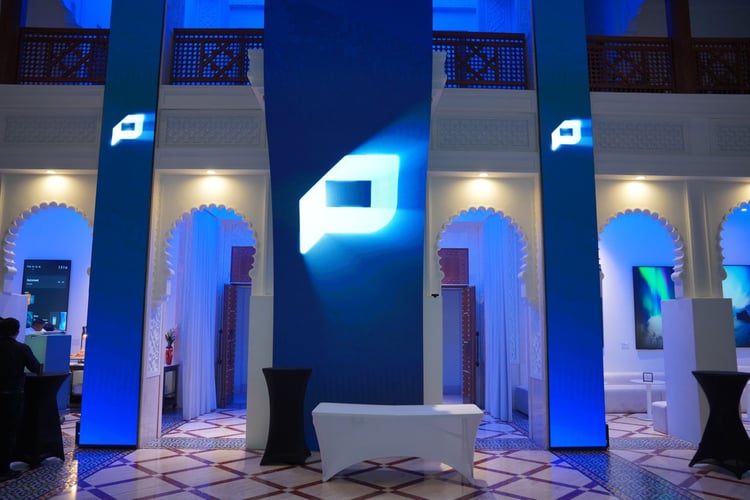
Issuer Academy - Excelling with a unique payment proposition
Dubai set the stage for something special.
The first Issuer Academy Masterclass brought together industry leaders, builders and innovators to explore what it truly takes to design, launch and scale unique payment propositions in one of the world’s most dynamic regions. From next-generation attitudes and cloud-native architecture to tokenization, ecosystems and financial inclusion, the masterclass moved beyond theory into the practical realities shaping the future of issuing across the Middle East.
What followed was a packed room, high energy and a full day of honest, forward-looking conversations led by those actively building and operating next-generation payment platforms.
Leadership, vision and the pace of change
The day opened with a powerful keynote from Jeff Parker, introduced by global speaker Dave Crane, immediately setting the tone for a room of collective excellence. Jeff walked the audience through Paymentology’s MENA journey, grounding the discussion in the realities of building a truly global issuing platform while meeting the needs of sophisticated customers, ambitious regulators and fast-moving markets.
He spoke to digitisation, dynamic controls and the power of real-time data and FAST feed in unlocking behavioural insights. A defining moment was the introduction of PayCredit, a brand-new credit ledger built from the ground up by credit experts to support modern, flexible and scalable credit products. Jeff also explored the accelerating shift to tokenization, referencing Mastercard’s announcement on the removal of traditional 16-digit card numbers by 2030, a clear signal that the foundations of payments are changing.
How consumer behaviour is evolving
From leadership and vision, the conversation moved into how consumer behaviour itself is evolving. Leda Glyptis, author of Beyond Resilience and Bankers Like Us, delivered a keynote that challenged long-held assumptions about cards and payments. Drawing on research and lived experience, she described how cards moved from being reluctantly used to becoming the preferred payment method globally, including across the Middle East.
But the future, she argued, lies beyond plastic. Leda introduced the rise of agentic commerce, sharing a striking insight thatlast year, 6% of adults in the UK were willing to type their card details directly into ChatGPT and ask it to book a holiday. That number is increasing. As AI agents increasingly make decisions on behalf of consumers, issuers face urgent questions around relevance, fraud, liability and where to invest next. Her message was clear, cards are no longer fighting for relevance, they are fighting to win.
Why mindset now matters most
The theme of evolution continued with Nauman Hassan, Regional Director for MENA, who delivered one of the most resonant sessions of the day. He made a simple but powerful point that technology alone does not win, it needs attitude.
Nauman described what he called the next-generation attitude, one that is bold, restless and unapologetically focused on building the future without asking for permission. He defined this mindset through three pillars which were speed as the baseline, flexibility as the oxygen and data as the superpower. This shift from fear-based governance to opportunity-based leadership reframes technology not as an enabler, but as the brand, the experience and the proposition itself.
Why architectural rigidity is the biggest risk in payments
From mindset to mechanics, Tim, Paymentology’s CTO, took the stage to explore how architecture can either enable progress or quietly undermine it. He challenged the idea that fraud or downtime are the biggest risks in payments today. Instead, he argued, architectural rigidity is now the greatest threat.
Payments no longer evolve every five to ten years. They change every quarter, sometimes every month. Regulation shifts, new schemes emerge, consumer expectations accelerate and fraud patterns mutate constantly. Tim reframed what it really means to be cloud-native, explaining that it is not a hosting decision but an operating model built around elasticity by design, resilience as a feature and real-time data as a core asset.
He also highlighted the growing importance of localisation, where platforms must support domestic schemes and sovereign requirements without becoming bespoke and fragmented. Designing for scale is no longer enough, instead, designing for change is what will define the winners.
Tokenization as a growth and experience engine
Tokenization took centre stage in a practical and highly engaging session from Michael. Resetting common misconceptions, Michael focused on card tokenization as the removal of sensitive card data and its replacement with secure, environment-specific digital identifiers.
The real shift, he explained, is that tokenization is no longer just about security. It is about experience and differentiation. From push provisioning and Click to Pay to web provisioning and in-app token controls, modern tokenization enables faster onboarding, lower fraud, greater engagement and reduced operational burden. When implemented well, it quietly powers safer, smarter and more scalable payments.
Designing for choice
Behaviour remained a central theme, brought into sharp focus by Shahez’s product session. Impact, he argued, is not created when a feature exists, but when people choose to use it.
By examining why cash continues to work, Shahez demonstrated how digital payments can outperform it by being even simpler, safer and more adaptive. Instant issuance, real-time spend controls and web provisioning, when combined, redefine when, where and why a card is used. From everyday spending to insurance payouts and travel disruption, digital experiences can now win by design, not force.
The realities fintech cannot afford to ignore
Ali grounded the conversation in hard-earned lessons from more than a decade of advisory work across the Middle East and Africa. Most fintechs, he said, do not fail because of bad ideas. They slow down because of how they build.
Ali spoke to the importance of embedding compliance from the start, maintaining flexibility as roadmaps evolve, using real-time data to inform decisions and choosing infrastructure that supports expansion without repeated reinvention. His advice was simple and resonant: build smart from the start.
Ecosystems and partnerships as the operating model
The role of partnerships and ecosystems came into focus in a session led by Merusha, who challenged the assumption that building everything in-house leads to better outcomes. Payments, she reminded the audience, never happen in isolation.
She introduced the Four Ps framework, purpose, platform, partnerships and performance, as a method for building ecosystems that scale. Strong ecosystems combine global schemes, domestic schemes, cloud providers, core banking platforms, partners such as Mawarid and Zand, and specialist partners to remove friction and accelerate growth. Partnerships, she concluded, are not optional. They are the operating model.
Scaling with the user at the centre
One of the most engaging moments of the day was a fireside chat between Tim and Talal Toukan, Co-Founder and Head of Engineering at Ziina. Talal shared Ziina’s journey from peer-to-peer payments to serving both consumers and SMEs across the UAE, highlighting how unexpected user behaviour often reveals the next growth opportunity.
He spoke candidly about scaling with a lean engineering team, balancing speed and quality, and why early architectural decisions matter. His advice resonated across the room: always work from the user experience backwards.
Financial inclusion in action
The masterclass closed on a deeply human note with an inspiring session from Ehsan Rahman, Co-Founder and CEO of Kamel Pay. Ehsan shared how Kamel Pay reimagined payroll as a journey rather than a transaction, serving hundreds of thousands of blue-collar workers across the UAE.
By solving for employers first, the platform unlocked financial visibility, access and dignity for employees, including payroll-backed lending that replaced informal alternatives. It was a powerful reminder that payments innovation, when driven by empathy and intent, can improve livelihoods as well as balance sheets.
A new chapter for Issuer Academy in the Middle East
As the first Issuer Academy Masterclass in Dubai came to a close, one message stood out above all others. The future of payments is not being built through technology alone. It is being shaped by mindset, architecture, partnerships, real-world insight and a relentless focus on human impact.
The Issuer Academy has only just begun. And in the Middle East, the opportunity to excel with unique payment propositions has never been greater.
Related articles


Interview with the CISO: How embedding security across every facet of Paymentology’s business is providing a platform for innovation
June 12, 2025