How to launch a stablecoin-linked card programme

Contents
A stablecoin-linked card gives your customers a choice. They can keep their funds in stablecoins or use them for everyday purchases online and in store.
If you’re adding card spending to an existing product, three early decisions shape the launch: how customers will fund purchases, who will issue the cards and who will process the payments. This guide explains how a purchase works and walks you through the steps from choosing your first market to running a pilot.
What is a stablecoin-linked card programme?
A stablecoin-linked card programme lets customers use the value they hold in stablecoins to fund purchases with a physical or virtual card. The merchant accepts the payment through its usual card setup and is paid in fiat, such as pounds or euros.
The card gives customers a practical off-ramp from stablecoins to everyday spending. Programmes can convert stablecoins at checkout or let customers spend from a fiat balance funded in advance.
Why wallets and exchanges add card spending
For wallets, card spending makes incoming funds more useful. Someone who receives freelance payments in stablecoins can keep part of what they earn in their wallet and use the rest for groceries or subscriptions.
For exchanges, card spending gives customers a reason to use their account between trades. Customers who hold stablecoins on the exchange can use part of that balance for everyday purchases without first withdrawing it to a bank account.
How a stablecoin-linked card payment works
A customer taps their card to pay for groceries. The shop sends the payment request through its usual card network, in local currency. On the issuing side, the programme checks whether the customer has enough funds and whether the purchase meets the card’s spending rules.
In a programme that converts at checkout, the customer’s stablecoins are converted into fiat to fund the purchase. The shop receives payment in fiat through its usual payment provider.
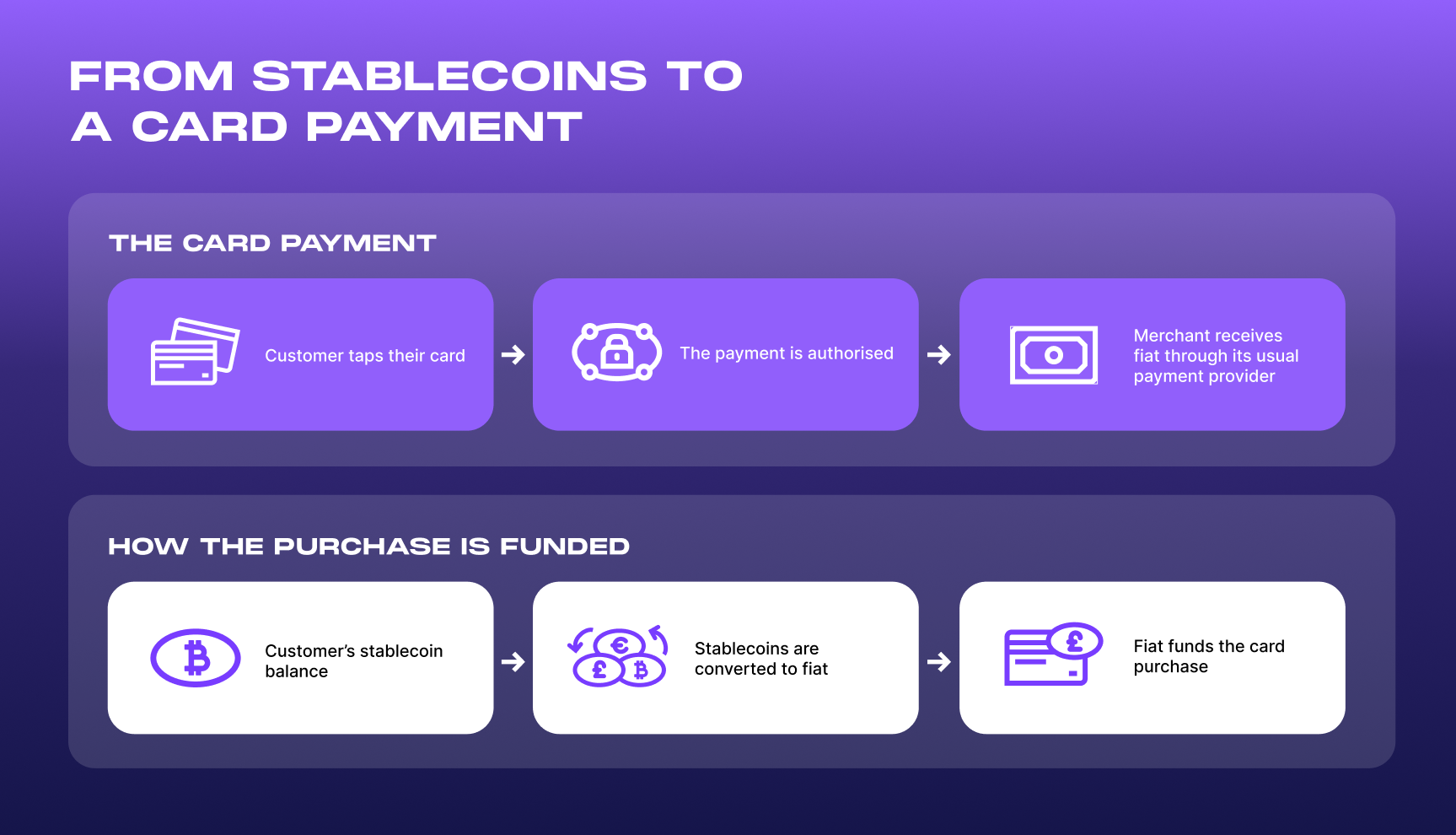
With a prefunded programme, the stablecoins are converted before the customer shops. The card then draws on the resulting fiat balance. The customer can still pay with the same tap. What changes is when the conversion happens.
Who’s involved in a stablecoin-linked card programme?
|
Role |
What they do |
| Wallet or exchange | Offers the card to customers and typically manages the in-app experience, including how customers access their card and view their purchases. |
| Issuer or BIN sponsor | The issuer issues the cards under its card network membership. A BIN sponsor provides access to its issuing arrangement for businesses that need one. |
| Issuer processor | Handles card transactions on the issuing side, including authorisation requests, and supports controls such as spending limits. |
| Conversion and settlement partners | Depending on the setup, specialist partners may convert stablecoins into fiat, make funds available for card purchases or support settlement. |
| Card network | Routes transactions between the merchant’s payment provider and the issuing side, and sets the rules for how those transactions are processed. |
Check BIN sponsorship in your launch market
If you already issue cards or work with a BIN sponsor, confirm that your existing arrangement supports stablecoin-linked cards and your proposed funding model in your first market. If you need a sponsor, check whether a suitable one is available for that market and programme before you scope the integration.
Five steps to launch a stablecoin-linked card programme
1. Choose your first market and use case
Decide where you’ll launch, who will get the card first and which purchases you want to support. An online spending pilot may only need virtual cards. If in-store spending is central to the offer, consider whether customers will use a virtual card in a mobile wallet, a physical card or both.
2. Confirm who will issue and process the cards
Start with your existing setup. If you already issue cards, confirm whether you can use that arrangement for the new programme. If you have a BIN sponsor, review the proposed programme with them. If you need one, identify a suitable sponsor for your first market. Once you know who will issue the cards, confirm which issuer processor will support the programme and what your team needs to integrate.
3. Agree how funding, settlement and refunds will work
Once you’ve chosen a funding model, agree who will handle conversion, make funds available for card payments and support settlement. Walk through a purchase and a refund with your partners. Decide where refunded funds will go and how the refund will appear in the customer’s account.
4. Assign responsibility for running the programme
Agree who owns cardholder onboarding, fraud monitoring, disputes and customer support. Work through a real support scenario with your partners. If a payment is declined even though the customer has enough funds, who can investigate the decline, and who explains it to the customer?
5. Integrate, test and run a pilot
Test card activation, purchases, declines and refunds before inviting a small group of customers to try the programme. Check that what customers see in the app matches your team’s and partners’ records. Use what you learn from payment failures, reconciliation and support requests to decide what needs fixing before a wider rollout.
Faster time-to-market
A proven fintech blueprint and a streamlined path to launch. Weeks, maybe. Months, probably. Years? Not likely.
Global reach
Local expertise and scheme access in 50+ markets. You can expand into new corridors without building a knowledge base from scratch. Seriously, check out our Developer Portal.
Full card programme flexibility
Consumer debit, credit, prepaid, B2B, virtual: all on one platform. You build the card proposition that fits your customers.
Real-time data & controls
Real-time transaction-level insights to understand behaviour, personalise the experience, and optimise performance. Cardholder control for spending limits, some security settings, and approvals. All configurable at card level.
Digital wallet support
Apple Pay, Google Pay, and Samsung Pay for now. And whatever the next Big Thing will be.