What’s Brewing in Poland? The Market Quietly Changing the Rules of Credit
Something significant is happening in Poland and it’s been building for years.
Over the past three decades, Poland has scaled its economy by roughly 17 times, establishing itself as one of Europe’s fastest-growing markets. Its total economic output now exceeds that of multiple Eastern European economies combined, while its per-capita wealth has converged with advanced economies such as Japan.
Yet, while the macro story is impressive, what’s even more compelling is what’s happening beneath the surface, particularly in fintech.
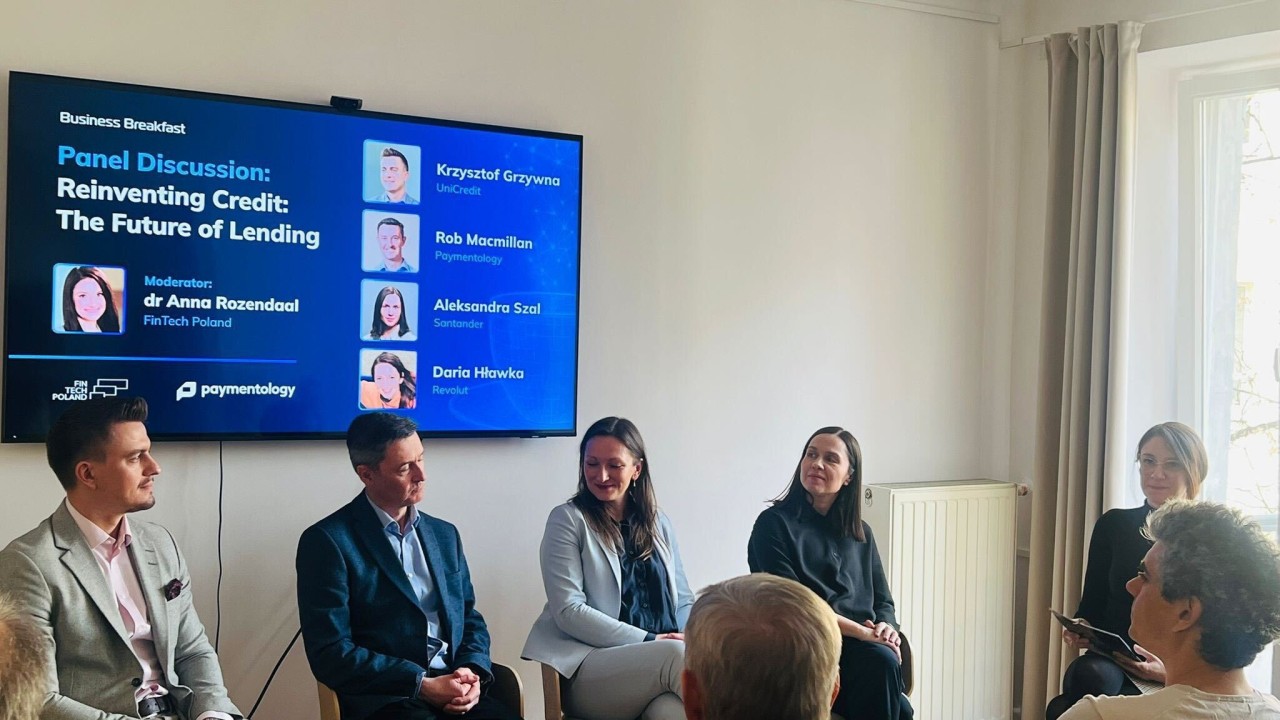
At the recent Fintech Poland Business Breakfast, industry leaders came together to explore how credit is changing in practice. The conversation quickly moved beyond traditional definitions of credit into something much broader, more like a rethinking of how the credit industry works altogether, from embedded finance to smarter analytics and real-time, adaptive models.
A payments leader with a distinct credit identity
Poland’s fintech scene, by any measure, is a highly advanced digital payments market. Mobile-first behaviour is the norm, with solutions like BLIK reaching more than 20 million users and contactless payments embedded into everyday life. Consumers are comfortable with digital interactions and expect speed and simplicity as standard.
At the same time, the country’s credit profile looks very different from more mature Western markets. Credit card penetration remains relatively low, while debit usage dominates. Instead, instalment-based credit has become deeply ingrained in consumer behaviour, shaping how people think about borrowing and repayment.
This combination creates a powerful foundation for innovation. On one hand, consumers are ready for sophisticated, digital-first experiences. On the other, the credit arena is fragmented and still evolving, opening the door for entirely new models to emerge.
From fragmentation to embedded credit experiences
A central theme of the breakfast was the move away from static credit products toward dynamic, transaction-level decisioning.
As highlighted during the session delivered by our PayCredit Group Product Manager, Rob Macmillan, today’s credit experience often feels disjointed. Many consumers hold multiple credit agreements across different providers, creating journeys that are difficult to navigate and lacking a unified view of risk or affordability. This fragmentation not only impacts user experience but also limits the ability to deliver more contextual decisions.
What is emerging instead is a model where credit becomes far more fluid and responsive. Such decisions are increasingly being made in real-time, at the point of transaction, and embedded directly into the payment experience itself. Rather than applying for credit as a separate step, consumers are presented with options exactly when they need them.
Two models are beginning to define this shift. The first is programmable, card-based credit, where a single card can offer multiple repayment options such as paying immediately, deferring payment, or splitting it into instalments. Crucially, the decisioning can happen before, during, or even after a purchase, often orchestrated through digital wallets.
The second, more advanced model is what can be described as intelligent credit. Here, the process moves beyond simple approval decisions and into active financial guidance. By analysing transaction history and behavioural data, systems can recommend repayment structures in real-time, redirecting the focus from borrowing to managing cash flow more effectively. In this world, credit becomes less about access to funds and more about optimisation.
The infrastructure you don’t see, but can’t live without
Another key theme from the event was the growing importance of invisible infrastructure.
Our Head of Sales Europe, Ignacio Gironella Merino, captured this perfectly with a simple but powerful analogy which was that tokenization is like electricity, it’s something you never think about when it works, but immediately notice when it doesn’t.
This framing resonated because it highlights a fundamental truth about modern fintech. The technologies that matter most are often the least visible. Tokenization underpins security, trust and frictionless user experiences, enabling everything from safe transactions to smooth payments. It is not a feature in itself, but a critical enabler of everything else.
As the industry moves toward increasingly embedded and real-time experiences, the reliability of this infrastructure becomes non-negotiable.
Credit becomes ambient
One of the clearest signals from the panel discussion was that payments are fading into the background of everyday life.
As one panellist described, the experience is becoming almost invisible, applying for credit while making your morning coffee and receiving a decision before you’ve even finished it. This is the new benchmark; financial experiences that are instant, embedded and seamlessly integrated into everyday moments.
In this model, credit is no longer a standalone product that requires deliberate engagement. Instead, it becomes part of the natural flow of daily activity, present when needed and unobtrusive when not.
A market moving at multiple speeds
Despite this rapid progress, different demographic groups bring different expectations, which creates a complex design challenge. Younger consumers are driving demand for instant decisions, embedded experiences and minimal friction, reflecting broader digital-native behaviours. Meanwhile, older segments continue to value more traditional credit models, where trust, transparency and familiarity remain critical.
This means that innovation in payments is not just about speed or technology. It is about building systems that can accommodate multiple behavioural profiles simultaneously, without compromising on experience or responsibility.
Opportunity and responsibility in embedded finance
Poland represents a significant opportunity for embedded credit, but it also highlights the risks that come with it.
The combination of digitally engaged consumers, low reliance on traditional credit cards and widespread acceptance of instalment-based models creates ideal conditions for new forms of credit to scale quickly. At the same time, the market remains fragmented and is still defining its long-term structure, which introduces both competitive pressure and uncertainty.
As discussed during the panel, this is ultimately a double-edged sword. When executed well, it strengthens trust and deepens customer relationships. When executed poorly, it can damage brand credibility, particularly as non-financial companies begin to offer credit products directly within their platforms.
Layered on top of this is the emergence of agentic commerce, where systems act on behalf of users to make financial decisions. While this opens up powerful new possibilities, it also raises important questions around governance, control and accountability. The future may be automated, but it must be built on the right guardrails.

.png)